SEO vs Paid Ads: Which Is Better for Long-Term Business Growth?
Every business aiming to grow online eventually faces a critical decision: invest in search engine optimisation or allocate budget to paid advertising. Both channels promise visibility, traffic, and conversions, but they operate on fundamentally different principles. Choosing the right approach is not simply a matter of preference. It requires understanding how each channel contributes to growth, how sustainable the results are, and how they align with your long-term business objectives.
This is not a question of which channel is universally better. It is a question of which channel delivers lasting value and how each should be used strategically.
Understanding the Core Difference
Search engine optimisation is a long-term strategy focused on improving your website’s visibility in organic search results. It involves building authority, optimising content, and creating a technically sound website that search engines trust.
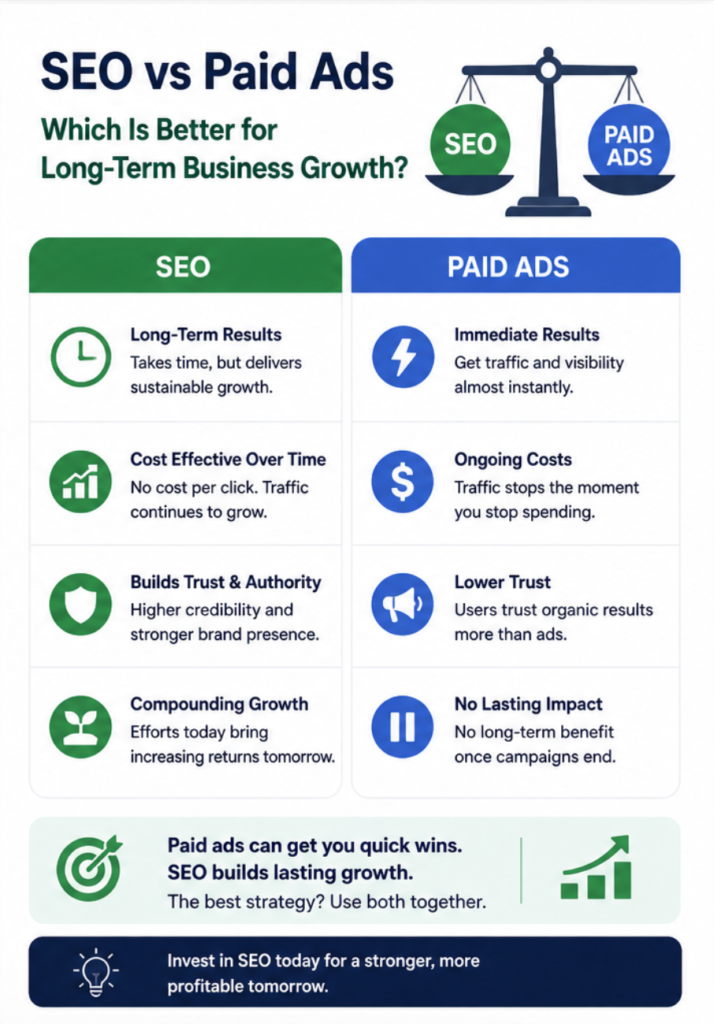
Paid advertising, on the other hand, delivers immediate visibility by placing your website at the top of search results or across digital platforms through a bidding system. You pay for each click or impression, and traffic stops the moment you stop spending.
The distinction is simple but significant. SEO builds an asset. Paid ads rent visibility.
The Speed of Results vs the Sustainability of Growth
Paid advertising is often appealing because of its speed. Campaigns can be launched quickly, and traffic can begin flowing almost immediately. This makes it particularly useful for new businesses, product launches, or time-sensitive promotions.
However, this speed comes with a limitation. The results are directly tied to the budget. Once spending stops, visibility disappears. There is no residual benefit from past campaigns beyond the data collected.
SEO operates on a different timeline. It requires patience and consistent effort before results become visible. Rankings improve gradually as search engines recognise your website’s authority and relevance. While this slower pace can be challenging, the outcome is significantly more durable.
Once your website achieves strong rankings, it continues to attract traffic without ongoing payment for each visitor. The effort invested compounds over time, creating a stable and scalable source of organic traffic.
Cost Structure and Return on Investment
Paid advertising offers predictable and controllable costs. You can define budgets, adjust bids, and scale campaigns based on performance. This level of control makes it easier to forecast short-term outcomes.
However, the cost per click in competitive industries can be high, and maintaining visibility often requires continuous investment. Over time, this can lead to increasing acquisition costs, particularly if campaigns are not optimised effectively.
SEO requires upfront investment in strategy, content, and optimisation. The costs are typically associated with expertise and execution rather than direct traffic acquisition. While the initial return may appear lower compared to paid ads, the long-term return is significantly higher.
As organic rankings improve, the cost per acquisition decreases. Traffic generated through SEO does not carry a per-click cost, which allows businesses to scale without proportionally increasing expenditure.
Traffic Quality and User Intent
The effectiveness of any marketing channel depends not just on traffic volume but on the quality of that traffic.
Paid ads allow precise targeting based on demographics, interests, and behaviour. This enables businesses to reach specific audiences quickly. However, users are often aware that they are clicking on advertisements, which can influence trust and engagement.
Organic search traffic is driven by user intent. When a website ranks naturally for a query, it is perceived as more credible and relevant. Users tend to trust organic results more than paid placements, particularly for informational and research-driven queries.
This difference in perception often leads to higher engagement and stronger long-term relationships with users who discover your website through organic search.
Choosing the right growth strategy can define your long-term success. If you are evaluating how SEO can contribute to sustainable results, explore our SEO services to see how Nexic Technologies builds scalable organic growth strategies.
Credibility and Brand Authority
Appearing consistently in organic search results strengthens your brand’s authority. It signals to users that your website is a trusted source of information within your industry.
SEO contributes to brand building by positioning your business as an authority across multiple topics and queries. This visibility extends beyond individual campaigns and supports broader marketing efforts.
Paid advertising, while effective for visibility, does not inherently build authority in the same way. It places your brand in front of users, but it does not carry the same level of implicit trust as organic rankings.
Over time, businesses that invest in SEO tend to develop stronger brand recognition and credibility, which influences both traffic and conversion rates.
Scalability and Long-Term Impact
Scalability is a critical factor when evaluating marketing channels. Paid advertising scales by increasing the budget. More spending leads to more visibility, but it also increases overall cost.
SEO scales through expansion and optimisation. As your website grows, you can target more keywords, create additional content, and capture a wider audience. Each improvement builds on previous efforts, creating a compounding effect.
This compounding nature is what makes SEO particularly valuable for long-term growth. A well-optimised website becomes a central asset that supports multiple marketing objectives, from lead generation to brand awareness.
Risk and Dependence
Reliance on a single traffic source introduces risk. Paid advertising platforms can change bidding structures, increase competition, or adjust policies, all of which can impact performance and costs.
SEO is not without risk, as search engine algorithms evolve and competition increases. However, a well-executed SEO strategy that focuses on quality, relevance, and user experience tends to remain resilient over time.
The key difference lies in dependence. Paid ads require continuous funding to maintain results, while SEO reduces dependency on external platforms by building your own organic presence.
When Paid Ads Make Strategic Sense
Despite its limitations, paid advertising plays an important role in a comprehensive marketing strategy. It is particularly effective for generating immediate traffic, testing new offers, and capturing high-intent users in competitive spaces where organic rankings may take time to achieve.
Paid ads also provide valuable data. Insights from campaign performance can inform keyword strategy, audience targeting, and messaging, which can then be applied to SEO efforts.
The strength of paid advertising lies in its immediacy and flexibility, not its long-term sustainability.
When SEO Becomes the Stronger Investment
SEO becomes increasingly valuable as a business focuses on long-term growth, cost efficiency, and brand authority. It is especially effective for businesses that rely on consistent lead generation and want to reduce dependency on paid channels.
As organic traffic grows, businesses gain greater control over their customer acquisition process. This stability allows for more predictable growth and better allocation of marketing resources.
SEO also supports other channels. High-quality content can be repurposed across social media, email marketing, and paid campaigns, creating a unified and efficient marketing ecosystem.
The Strategic Balance Between SEO and Paid Ads
The most effective approach is not choosing one over the other but understanding how they complement each other.
Paid ads can deliver immediate results and provide data-driven insights, while SEO builds a sustainable foundation for long-term growth. Together, they create a balanced strategy that addresses both short-term needs and future scalability.
However, for businesses evaluating where to prioritise investment, SEO offers a more enduring return. It transforms your website into a continuous source of traffic and leads, rather than a channel that requires constant funding to remain active.
Conclusion
The comparison between SEO and paid advertising ultimately comes down to time horizon, cost structure, and strategic intent. Paid ads provide speed and control, but their impact is temporary. SEO requires patience and consistent effort, but it delivers lasting value.
For long-term business growth, SEO stands out as the stronger investment. It builds authority, reduces acquisition costs over time, and creates a sustainable flow of high-quality traffic.
Businesses that prioritise SEO are not just investing in visibility. They are building a digital asset that continues to generate returns long after the initial work is done.