
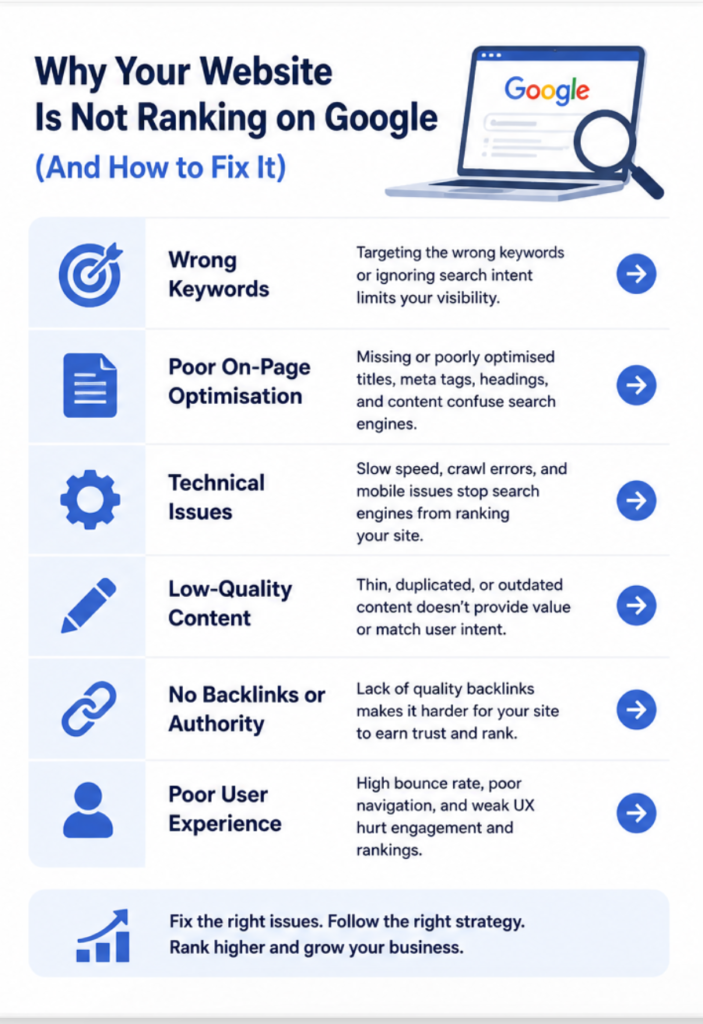
Why Your Website Is Not Ranking on Google (And How to Fix It)
A website that fails to appear on the first page of search results is effectively invisible to potential customers. Despite investing in design, development, and content, many businesses struggle to gain traction in search rankings. The issue is rarely a single mistake. In most cases, it is a combination of technical weaknesses, poor strategy, and misalignment with how search engines evaluate websites.
Understanding why your website is not ranking requires a clear look at how search engines operate and what they prioritise. More importantly, it requires identifying the specific gaps that are holding your website back and addressing them with a structured approach.
The Reality of Search Rankings
Search engines are designed to deliver the most relevant, useful, and trustworthy results for every query. Ranking is not based on appearance or intention. It is based on measurable signals such as content quality, technical performance, authority, and user experience.
If your website is not ranking, it means that search engines do not yet see it as the best answer for the queries you are targeting. This does not imply that your business lacks value. It indicates that your website is not effectively communicating that value in a way that search engines can understand and trust.
If your website is struggling to rank, the issue is rarely surface-level. A structured, data-driven approach is required to identify and fix the underlying problems. Explore our SEO services to understand how Nexic Technologies can help you turn your website into a high-performing asset.
Weak or Misaligned Keyword Strategy
One of the most common reasons websites fail to rank is poor keyword targeting. Many businesses either target keywords that are too competitive or choose terms that do not reflect actual user intent.
Targeting broad, high-volume keywords may seem attractive, but these terms are often dominated by established, high-authority websites. Competing without a strategic approach makes ranking extremely difficult. On the other hand, targeting irrelevant or low-intent keywords results in traffic that does not convert, which weakens overall performance signals.
The solution lies in identifying keywords that balance search demand with realistic competition while aligning closely with what your audience is actively searching for. This includes focusing on long-tail keywords and intent-driven queries that indicate a higher likelihood of conversion.
Poor On-Page Optimisation
Search engines rely on on-page signals to understand what your content is about. If these signals are unclear or inconsistent, your pages will struggle to rank.
Common issues include missing or poorly written title tags, weak meta descriptions, improper heading structure, and a lack of keyword alignment within the content. In many cases, websites either overuse keywords in an unnatural way or fail to use them strategically at all.
Effective on-page optimisation requires clarity and structure. Each page should have a defined focus, with content that directly addresses a specific topic. Search engines should be able to quickly identify the purpose of the page, while users should find it easy to navigate and understand.
Technical SEO Issues Limiting Performance
Even high-quality content cannot perform well if the technical foundation of a website is weak. Technical SEO ensures that search engines can crawl, index, and evaluate your website without obstacles.
Issues such as slow loading speeds, broken links, poor mobile responsiveness, and incorrect indexing settings can significantly impact rankings. If search engines cannot properly access your content, it will not appear in search results regardless of its quality.
Website speed has become a critical ranking factor, especially as user expectations continue to rise. A slow website increases bounce rates and reduces engagement, both of which send negative signals to search engines. Similarly, a lack of mobile optimisation can severely limit visibility, as the majority of searches now occur on mobile devices.
Resolving technical issues requires a thorough audit followed by targeted improvements. This includes optimising page speed, fixing crawl errors, ensuring proper indexing, and maintaining a clean site structure.
Low-Quality or Thin Content
Content remains one of the strongest ranking factors, but not all content contributes equally. Websites that rely on thin, generic, or duplicated content often struggle to gain visibility.
Search engines prioritise content that demonstrates depth, relevance, and usefulness. Pages that provide little value or fail to address user intent are unlikely to rank, regardless of how well they are optimised technically.
Creating high-quality content involves more than writing longer articles. It requires understanding what users are looking for and delivering comprehensive, well-structured information that satisfies that need. Content should answer questions, provide insights, and guide users toward meaningful action.
Consistency also plays a role. Websites that regularly publish valuable content signal ongoing relevance and authority, which strengthens their position in search results over time.
Lack of Backlinks and Authority
Search engines view backlinks as signals of trust and credibility. When other reputable websites link to your content, it indicates that your website provides value worth referencing.
A lack of backlinks is a major reason why many websites fail to rank, especially in competitive industries. Without authority, even well-optimised content may struggle to compete against established competitors.
However, not all backlinks are beneficial. Low-quality or spammy links can harm your website rather than help it. The focus should be on earning high-quality links from relevant and authoritative sources.
Building authority requires a strategic approach that includes content marketing, outreach, and creating link-worthy assets. Over time, this strengthens your domain and improves your ability to rank across multiple keywords.
Poor User Experience and Engagement Signals
Search engines increasingly rely on user behaviour to evaluate content quality. If users quickly leave your website or fail to engage with your content, it signals that your page may not be meeting their expectations.
Factors such as confusing navigation, cluttered design, intrusive pop-ups, and a lack of clear direction can negatively impact user experience. Even if your website ranks initially, poor engagement can lead to a decline in rankings over time.
Improving user experience involves simplifying navigation, enhancing readability, and ensuring that visitors can easily find what they are looking for. Clear calls to action and logical page structure help guide users and improve overall engagement.
Inconsistent SEO Efforts
SEO is not a one-time activity. Many businesses make initial improvements but fail to maintain consistency, which leads to stagnation or decline in rankings.
Search engines continuously update their algorithms and re-evaluate websites. Competitors are also actively improving their strategies. Without ongoing optimisation, your website will struggle to keep up.
Consistent effort includes updating content, monitoring performance, refining strategies, and adapting to changes in search trends. SEO should be treated as a long-term investment rather than a short-term project.
How to Fix Your Ranking Issues
Addressing ranking issues requires a structured and strategic approach rather than isolated fixes. The first step is conducting a comprehensive audit to identify weaknesses across technical, content, and authority factors.
Once these gaps are identified, improvements should be prioritised based on impact. Technical issues that prevent indexing or affect performance should be resolved first, followed by on-page optimisation and content enhancements.
Developing a clear content strategy is essential. This involves targeting the right keywords, creating valuable content, and maintaining consistency over time. Content should not only attract traffic but also engage users and encourage action.
Building authority through high-quality backlinks should be integrated into your overall strategy. This strengthens your website’s credibility and improves its ability to compete in search results.
Finally, continuous monitoring and optimisation ensure that your website adapts to changes and maintains its performance. SEO success is achieved through sustained effort and strategic refinement.
The Long-Term Value of Fixing SEO Issues
Improving your search rankings is not just about visibility. It directly impacts your ability to attract qualified traffic, generate leads, and grow your business.
A well-optimised website becomes a consistent source of organic traffic, reducing reliance on paid advertising and increasing long-term profitability. It also strengthens your brand’s credibility, as users tend to trust websites that appear at the top of search results.
Conclusion
If your website is not ranking on Google, it is not due to a single failure but a combination of factors that need to be addressed systematically. From keyword strategy and content quality to technical performance and authority, each element plays a critical role in determining your visibility.
The solution lies in adopting a comprehensive SEO approach that aligns with how search engines evaluate websites and how users interact with content. When executed correctly, SEO transforms your website from a passive presence into a powerful driver of business growth.